
Work · Public project
Knowledge Intelligence
A knowledge platform that answers from an organisation’s own documents and databases, cites the source of every claim, and limits each answer to what the person asking may read.
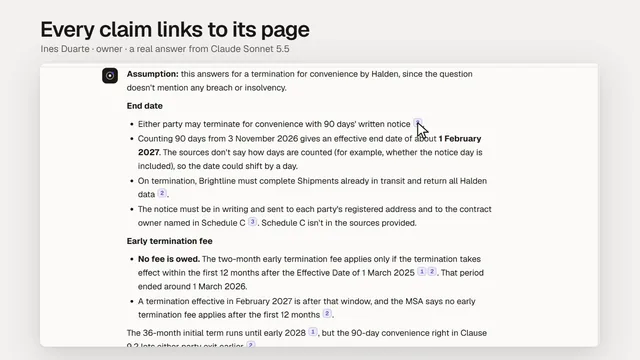
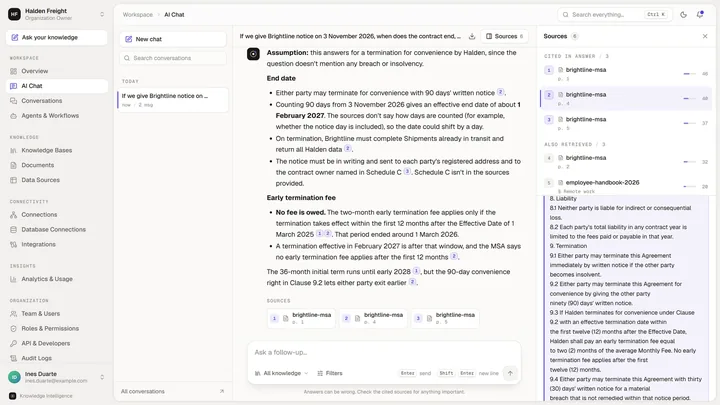
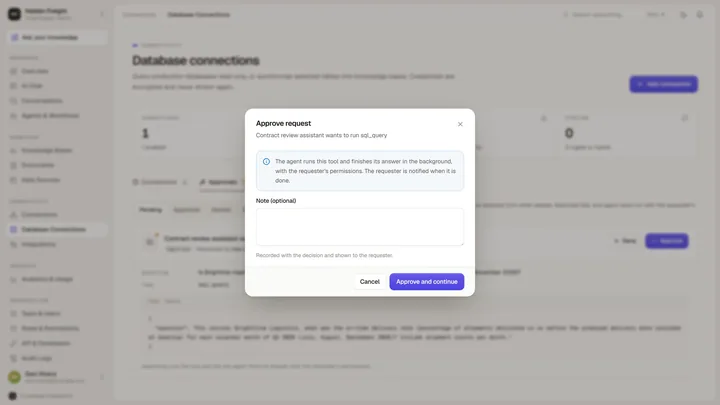
Recorded in the app with answers from Claude: a contract question answered with the clause it came from, the same question from a member who cannot open contracts, a database question run as read-only SQL, and an agent that waits for an admin’s approval before it queries the database. The company in the demo is fictional.
Project videos load from YouTube only when you press play.
What it is
Knowledge Intelligence is a multi-tenant knowledge platform. Organisations connect documents, spreadsheets, databases and web or code sources; members ask questions in a chat and get answers grounded in the sources they are allowed to see, with citations down to the page, sheet row or database query.
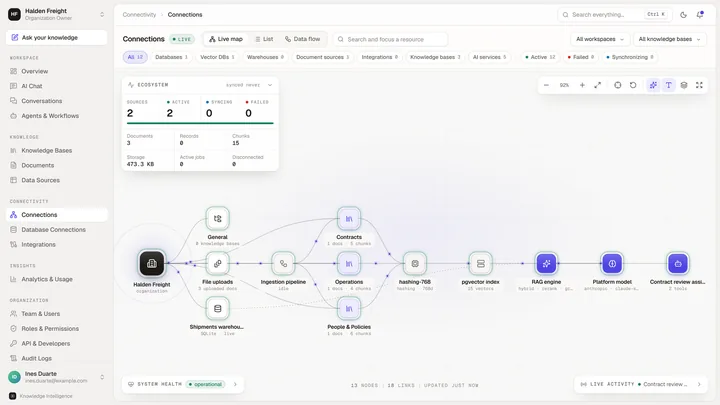
Around the chat sit Text-to-SQL for connected databases, agents with tools and approval gates, a live map of every source and model, an audit log, analytics and administration.
Process: what we built
Access is enforced in two places: row-level security on every tenant table in PostgreSQL, and permission checks inside each retrieval query, with roles, grants, deny rules and expiry. A member who cannot open a document never retrieves it, so it never reaches the model.
Retrieval combines pgvector embeddings with keyword search, then reranks. Every citation is checked against the passage it points to, and when the sources do not answer the question, the assistant says so instead of guessing.
Database questions become SQL that is parsed and checked against the selected tables, columns and row filters before it runs read-only. Agents work with the asking person’s permissions; a tool marked as sensitive waits until someone else approves it, and the run then picks up where it stopped. It is built with FastAPI, PostgreSQL with pgvector, sqlglot and Next.js, and answers with Claude, OpenAI or other model providers.
- 01Connect
- Documents, data and databases
- 02Retrieve
- Only what the person may read (where the system decides)
- 03Answer
- Verified citations
- Says so when sources fall short
- 04Query
- Checked, read-only SQL
- 05Act
- Agents with approval gates
Results and limits
Results
- In a 36-question test with four live Claude and GPT models, the cited sentences in every answer were supported by their sources (lexical faithfulness 1.00).
- 205 backend tests run on PostgreSQL with pgvector, including isolation between organisations; a browser test suite covers sign-in, cited answers, access control and the Connections map.
Limits
- Faithfulness here is a lexical check of the cited sentences, not a human judgement.
- Connectors for Google Drive, OneDrive, SharePoint, Dropbox, Notion, Confluence, Slack, Teams and email are in beta until each vendor’s app is registered.
- The company and documents in the demo are fictional.
Building something like this for a client?
We can build it under your agency’s brand, for a fixed project fee.