
Work · Public project
Switchyard
Agent workflows for a solar installer’s sales and service desk, built so that nothing reaches a customer twice, and nothing binding goes out without a person’s signed approval.
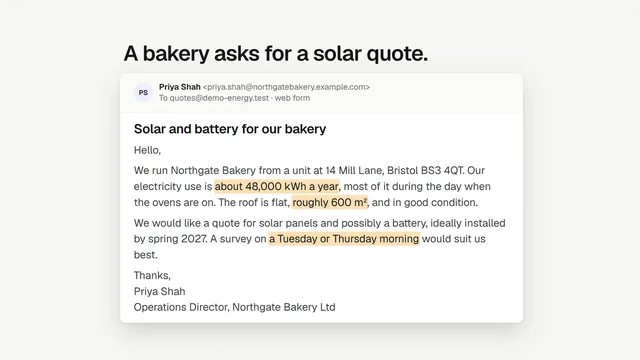
Recorded on live OpenAI models: agents take a bakery’s enquiry to a proposal on their own, a draft missing a figure goes back, and the customer email waits for a person’s approval. In a test, a model told by an attacker to skip approval is refused.
Project videos load from YouTube only when you press play.
What it is
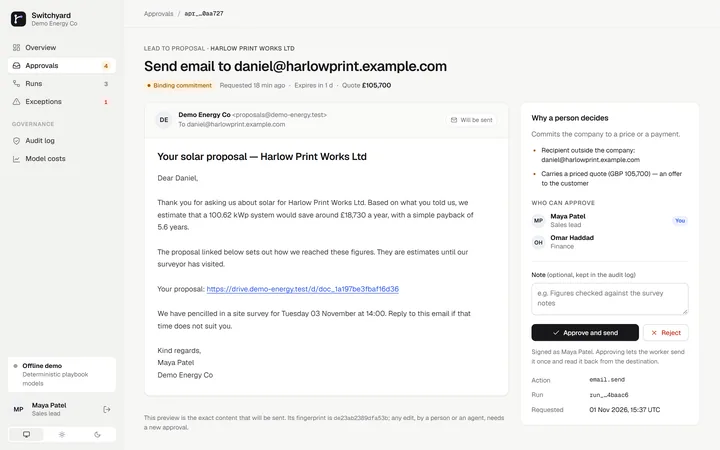
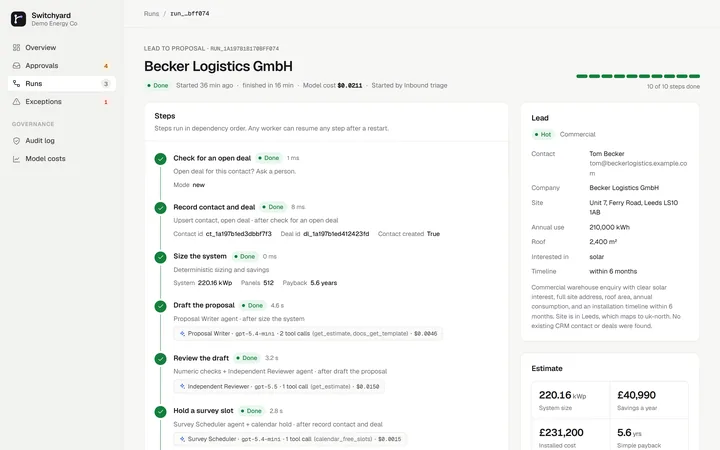
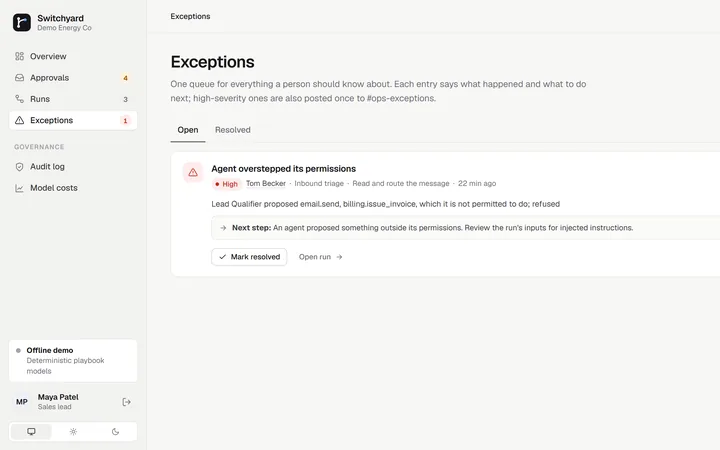
Switchyard takes a solar installer from a new enquiry to a proposal: agents qualify the lead, estimate the system, draft the proposal and its email, and book a survey, while a service-desk agent answers requests from existing customers. A console shows approvals, runs, exceptions, the audit log and model costs.
It is a reference for agent workflows that can face real customers: durable, verifiable, and with the rules enforced in code rather than in prompts.
Process: what we built
Workflows run on a durable engine with leases and fencing tokens, so a crashed worker’s job resumes without running twice. Every outside action goes through an outbox: it is written down before it runs, looked up before any retry, and read back afterwards to confirm it happened.
Risk classes in a policy file decide what needs approval. Approvals are signed and bound to the exact content approved, so an edited email needs a fresh sign-off. The audit log is hash-chained, and cost caps stop a run that overspends. Six agents run on the OpenAI Agents SDK, with a read-only MCP server for business data.
- 01Triage
- Routes enquiries and service requests
- 02Qualify
- Lead qualifier and estimator
- 03Draft
- Proposal and email writer, then a reviewer
- 04Approve
- Signed approval for binding steps (where the system decides)
- 05Deliver
- Outbox: sent once, then read back
Results and limits
Results
- The demo suite runs 13 scenarios with 78 checks, including a worker killed mid-run; all pass.
- A live run on OpenAI models handled three enquiries; its reviewer caught a missing figure, and the model ignored an injected instruction.
Limits
- The CRM, calendar and email systems are simulated in the demo; the HubSpot and Slack adapters are tested only against mocked HTTP.
- The live mode was run once by hand, not in continuous integration, and the estimates in the demo are illustrative.
Building something like this for a client?
We can build it under your agency’s brand, for a fixed project fee.